Flight school in Fort Myers: what it's really like before you spend a dollar
A flight school is where you earn an FAA pilot certificate: an instructor, an airplane, a syllabus and a checkride at the end. In Fort Myers that can mean a large academy or a one-on-one school like ours at Page Field. Here is how flight school actually works, what it costs, and how to choose one.
By Cristian Duran
Most people who search “flight school” are asking a bigger question underneath it: could I actually do this? The answer is almost always yes, and the path is more ordinary than it looks from the ground. A flight school is a place with an instructor, an airplane and a plan. You show up, you fly, you study, and at the end an FAA examiner checks that you can do the job.
This guide covers what flight school is, the two ways the FAA lets schools train you, what it costs, how long it takes, and what to look for when you visit one — written from Page Field (KFMY) in Fort Myers, where we train.
What a flight school actually does
A flight school does three jobs.
- It teaches you to fly. Dual instruction — you and a Certified Flight Instructor in the airplane together — from your first takeoff to the point where you can fly it alone and then pass a checkride.
- It teaches you to think like a pilot. Ground instruction covers aerodynamics, weather, regulations, navigation, airspace and decision-making. This is the half that the FAA written test checks, and it is the half that keeps you alive.
- It signs you off. Your instructor endorses your logbook at each step: first solo, solo cross-country, the written test, the checkride. Without those signatures, none of the hours count toward anything.
Everything else — the building, the website, the uniforms — is decoration. What you are buying is an instructor’s time and an airplane’s time, and the quality of both.
The certificates you can earn
Flight training is a ladder, and almost everyone starts on the same rung.
- Private Pilot License (PPL). The certificate that lets you fly yourself, friends and family, day or night, in good weather. The FAA minimum is 40 flight hours. This is where most students begin.
- Instrument Rating. Adds the ability to fly in clouds and low visibility by reference to the instruments, on an IFR clearance. Many pilots say it makes them safer even if they rarely use it.
- Commercial Pilot License. The certificate that lets you be paid to fly. It requires 250 total hours and a higher standard of precision. See how to become a commercial pilot.
- Flight Instructor (CFI). Lets you teach. Most career pilots instruct for a while to build the hours airlines require.
You do not have to decide on a career on day one. The private certificate is the foundation for every path, so the right first step is the same whether you want to fly to Key West for lunch or fly for an airline.
Part 61 vs Part 141: the two kinds of flight school
You will see “Part 61” and “Part 141” on almost every flight school website. They refer to two sections of the federal aviation regulations, and they describe how a school trains you, not how well.
Part 141 schools run an FAA-approved syllabus with fixed stage checks. They can graduate a student at slightly lower minimum hours (35 for the private certificate instead of 40), and they are often the route for student visas and some VA benefits. The trade-off is structure: the syllabus moves at its pace, not yours.
Part 61 schools — Core Aviator Training is one — train you to the same FAA standards and the same checkride, but the instructor builds the lesson plan around you. If you nail steep turns in one lesson, you move on. If crosswind landings take three more, you spend three more. For students who fly consistently and study at home, the “extra” five hours on paper rarely matters, because almost nobody finishes at the minimum under either part.
Neither one is better in every case. The question is which one fits how you learn and how you can schedule.
How long flight school takes
The real unit of flight school is not weeks. It is frequency.
The FAA minimum for a private certificate is 40 flight hours. Our students who keep up with their ground material usually reach checkride standard around 65 hours. Fly two or three times a week and that is a few months. Fly once every couple of weeks and it stretches toward a year, because the first part of every lesson is spent getting back to where you were.
That is why we run every lesson as a three-hour block — a real pre-flight brief, the flight itself, and a debrief that tells you exactly what happened and what comes next. Fewer, fuller lessons beat many rushed ones.
What flight school costs
Every school publishes rates differently, which is exactly what makes them so hard to compare. Ours are simple: the Piper Cherokee 140 is $190 per hour wet (fuel and maintenance included) and instruction is $60 per hour, in the air or on the ground. You pay for the session you just flew. There are no packages to prepay and no financing to sign.
What moves your total is how many hours you need, which comes back to frequency and preparation. For a full worked breakdown, from first lesson to commercial, read pilot training cost in Fort Myers. For the extras that never appear on a rate card — medical, exams, examiner, headset — read the line items nobody lists.
What a good flight school looks like
You can learn most of what you need from a single visit. Look for:
- One instructor who will stay with you. Instructor turnover is the most common reason students stall. Ask who will fly with you in month three.
- Airplanes that are actually available. A school with a long fleet list and a two-week wait for a slot is not cheaper than a small school you can book reliably.
- Published prices. If a school will not tell you the hourly rate before you visit, ask yourself why.
- A real brief and debrief. If lessons start at the airplane and end at the airplane, a lot of learning is being left on the ramp.
- A clean, cared-for airplane. You can tell a great deal about a school from its fleet. Ask to see the maintenance logs. A good school will be pleased you asked.
We wrote a longer list — twelve questions to ask on a visit — in pilot schools compared.
What flight school is like in Fort Myers
Where you train shapes what kind of pilot you become, and Southwest Florida is a very good place to learn.
Page Field is towered. KFMY has an air traffic control tower, so you talk to ground and tower from your very first lesson. At an untowered field, radio work is often added later as a separate skill. Here it is built in, and by the time you fly cross-country into unfamiliar airspace, the part that unnerves other students is the part you have done every lesson. More on that in learning to fly at Page Field.
The training area is easy to read from the air. The Caloosahatchee runs east, the Gulf coast and the barrier islands — Sanibel, Captiva, Fort Myers Beach — run south and west. Distinct shorelines make pilotage straightforward, and the scenery makes every lesson worth showing up for.
The weather is flyable most of the year. Southwest Florida gives you 300-plus flyable days. Summer afternoons build thunderstorms, so lessons are often scheduled early, and a weather cancellation is never charged.
It is close to home for most of the region. Students come to Page Field from Cape Coral, Naples, Estero, Bonita Springs, Lehigh Acres and Punta Gorda. A school you can reach in thirty minutes is one you will actually fly with twice a week.
How Core Aviator Training is different
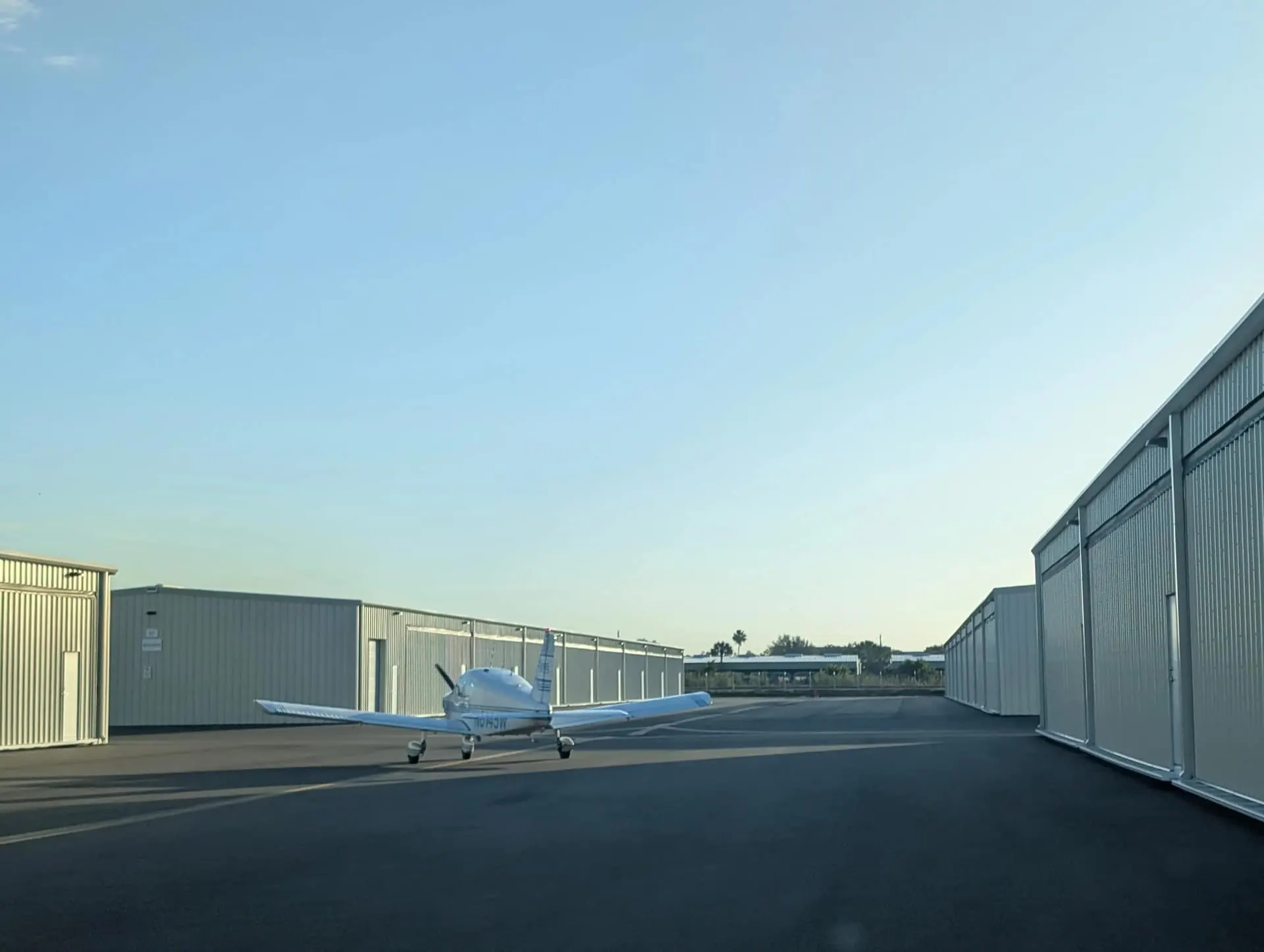
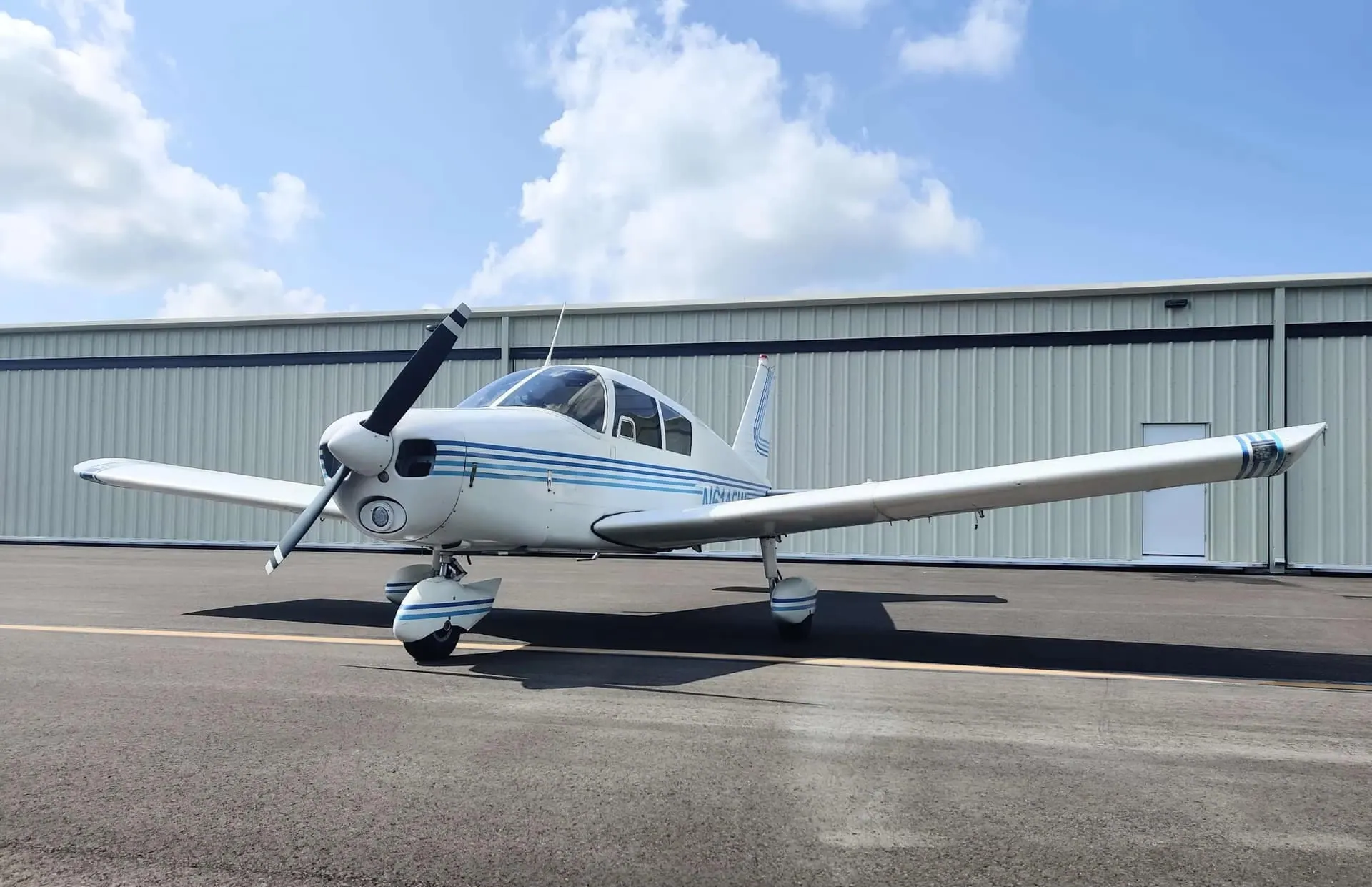
We built CORE as the opposite of the big-school pipeline. One Certified Flight Instructor — me — flies with every student from the Discovery Flight to the checkride. One airplane, N6145W, a Piper Cherokee 140 with a 150-HP Lycoming upgrade, kept immaculate. One student at a time, in three-hour blocks. You never start a lesson by re-explaining yourself to a new instructor, and you never wait for an airplane someone else has booked.
It is not the right fit for everyone. If you need a Part 141 syllabus for a visa or a specific benefit, a larger academy is the better call, and we will tell you so. If you want to learn properly, at your pace, from someone who knows your flying, it is exactly what we are for.
Questions people ask about flight school
Do I need any experience to start? No. Your first lesson assumes you have never touched an airplane.
Do I need a medical first? Not to start. You need an FAA medical certificate before your first solo, so most students apply during their first few weeks. See can I become a pilot if… for the medical questions people worry about.
How old do I need to be? You can start at any age. You must be 16 to solo and 17 to hold a Private Pilot certificate. There is no upper limit.
Is flight school hard? It is demanding, not mysterious. The students who do best are not the most talented — they are the ones who study between lessons and fly consistently.
The first step is one lesson
The best way to find out whether flight school is for you is to fly once. A Discovery Flight is $175. It is a real first lesson: a brief, you at the controls from the left seat over the Southwest Florida coast, and an entry in your logbook that counts toward your 40 hours.
We are booked up right now, so call 239-722-6751 and ask about the next opening. I answer my own phone.