How to become a commercial pilot: from zero to 250 hours out of Page Field
To become a commercial pilot you earn a Private Pilot License, add an Instrument Rating, build to 250 total hours, and pass the commercial knowledge test and checkride. You must be 18 and hold a second-class medical to fly for pay. Here is the full Part 61 path from Fort Myers, with the hour requirements and what each step costs.
By Cristian Duran
A Commercial Pilot License is the certificate that lets you be paid to fly. It is not the airline job itself — that takes an Airline Transport Pilot certificate and far more hours — but every professional pilot holds one, and it is the point where flying stops being something you pay for and starts being something you can be paid for.
This is the path from zero, under Part 61, the way students take it from Page Field (KFMY) in Fort Myers.
The path, in order
- Private Pilot License — the foundation. FAA minimum 40 hours.
- Instrument Rating — flying in clouds, on a clearance. Effectively required for any real commercial work.
- Time building — flying as pilot in command until you reach 250 total hours and meet the cross-country and night requirements.
- Commercial training — precision maneuvers, complex or technically advanced airplane time, and checkride preparation.
- Commercial knowledge test and checkride.
Many pilots then add a Flight Instructor certificate and teach while building toward airline minimums. More on that below.
The requirements
You must be at least 18, read, speak and understand English, and hold a second-class medical to exercise commercial privileges. A first-class medical is required later for airline captains, so many career students get a first-class medical at the start just to know where they stand.
For a single-engine commercial certificate under Part 61, the FAA requires at least 250 hours of flight time, including:
- 100 hours as pilot in command, including 50 hours of cross-country
- 20 hours of training with an instructor, including:
- 10 hours of instrument training
- 10 hours in a complex airplane, a technically advanced airplane or a turbine
- a 2-hour day cross-country and a 2-hour night cross-country, each more than 100 nautical miles from the departure point
- 3 hours of checkride preparation in the two months before the test
- 10 hours of solo (or acting as pilot in command with an instructor
aboard), including:
- a cross-country of at least 300 nautical miles with landings at three points, one leg at least 250 nautical miles
- 5 hours of night flying with 10 takeoffs and landings at an airport with an operating control tower
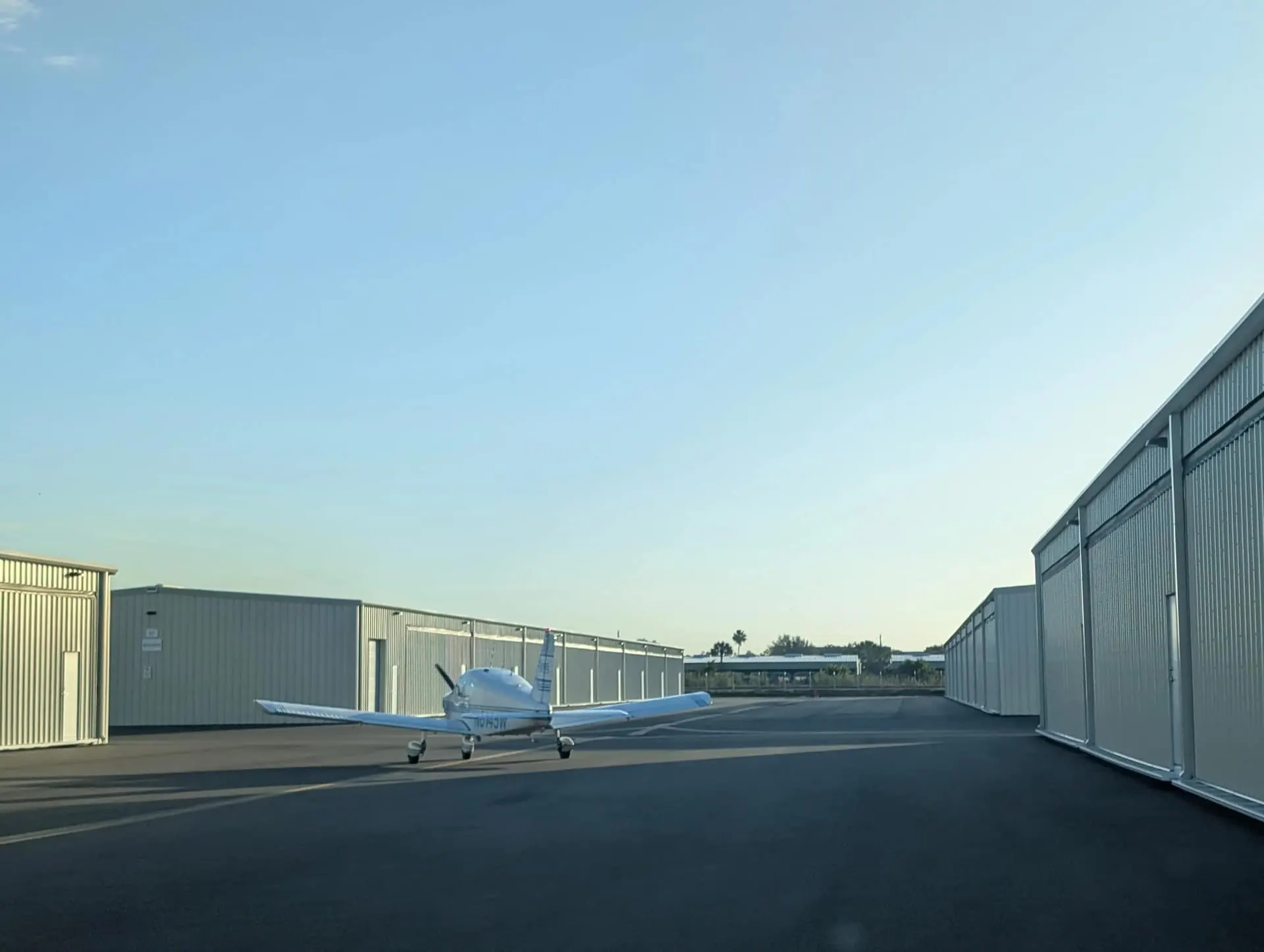
That last one is a useful thing about training at Page Field: it is a towered airport, so the night landings can usually be flown at home while the tower is open.
Why the Instrument Rating comes first
You can technically hold a commercial certificate without an Instrument Rating, but it comes with a limitation that rules out most paid flying: carrying passengers for hire on cross-country flights over 50 nautical miles or at night. In practice, career students earn the Instrument Rating before the commercial.
The instrument hours also count toward the 250, and the training makes you a far more precise pilot, which is exactly what the commercial checkride tests. Southwest Florida’s summer weather, with its afternoon convection and sea-breeze patterns, teaches instrument decision-making better than any textbook chapter.
Time building
Between the Instrument Rating (often around 100–120 total hours) and 250 hours sits the longest and most flexible part of the path. This is flying as pilot in command, solo or with another pilot, to build hours and meet the cross-country and night requirements.
It can be the most enjoyable stretch of training. From Page Field, the Gulf coast and the whole Florida peninsula are within reach. Plan your cross-countries with purpose: new airports, different airspace, night flights, longer legs. A pilot who builds 120 hours with variety is a far better pilot at 250 than one who flew the same local loop.
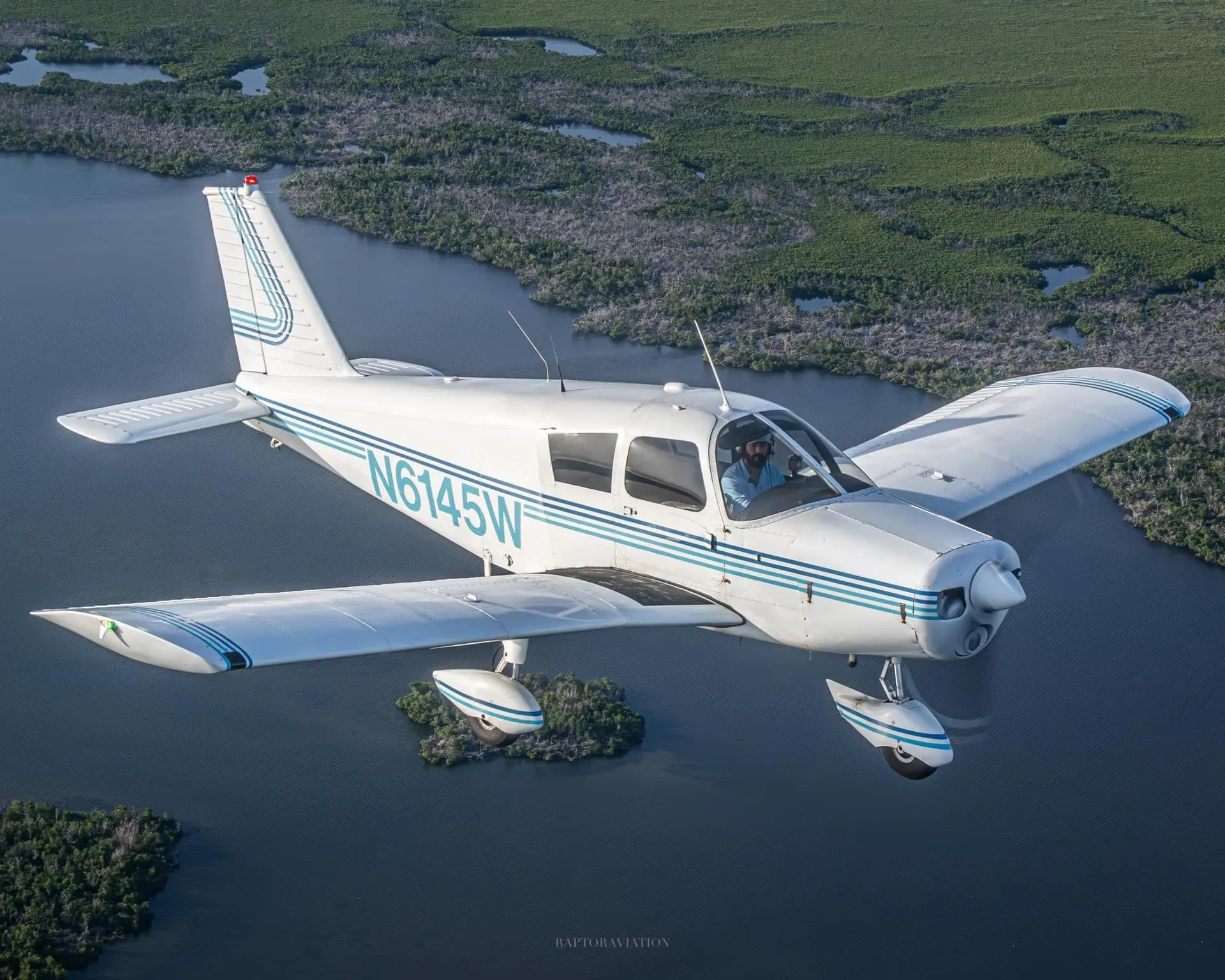
At Core Aviator Training, time building continues in the Cherokee 140 you already know, at the same pay-as-you-go rate, with no package to commit to.
The complex or TAA requirement
The FAA requires 10 hours of commercial training in a complex airplane (retractable gear, controllable-pitch propeller and flaps), a technically advanced airplane (a glass cockpit with an autopilot), or a turbine.
The Cherokee 140 is none of those. It is a superb trainer, but those ten hours are flown in a different aircraft, at its own rate. We will map where and when with you, so it slots into your plan rather than holding it up.
The commercial checkride
The commercial practical test, given by an FAA examiner, includes an oral exam and a flight with maneuvers flown to tighter standards than the private: steep turns, chandelles, lazy eights, steep spirals, eights on pylons, power-off 180° accuracy landings, and emergency procedures. You also pass a separate commercial knowledge test first.
The maneuvers are where one-on-one training pays off. Commercial standards demand exactness, and an instructor who already knows your flying gets you there faster.
What it costs
At our rates — $190 per hour wet for the airplane and $60 per hour for instruction — a Part 61 path from zero to a Commercial Pilot License with an Instrument Rating runs roughly $58,000–$65,500, paid as you go. The largest single block is time building. The full breakdown, step by step, is in pilot training cost in Fort Myers.
What a commercial pilot can do
With a commercial certificate and the right ratings, pilots work in banner towing, aerial survey and photography, tours, skydiving operations, pipeline patrol, ferry flights and, with a Flight Instructor certificate, teaching. Most of those jobs are hour-builders on the way to the airlines.
The airline step. Airlines require an Airline Transport Pilot certificate, which normally needs 1,500 hours and a minimum age of 23. Some approved degree programs and military pilots qualify with fewer hours. Most civilian pilots close the gap from 250 to 1,500 by instructing.
Becoming a flight instructor
Many commercial pilots add a Certified Flight Instructor (CFI) certificate right away. Instructing pays you to build hours, and it makes you a better pilot, because explaining every maneuver to a student is the fastest way to find out what you actually understand. We teach the CFI the same way we teach everything else: one-on-one, with a thorough brief and a straight debrief. See our training programs.
Where to start
If you are at zero, start with one lesson. A Discovery Flight is $175 and counts toward your private certificate, the first rung on the commercial ladder. If you already hold a private certificate, call and we will look at your logbook and map the fastest path from where you are. Either way, call 239-722-6751 and ask about the next opening.